
Soundmasking.com is the web site of Dynasound, Inc., the industry leader in sound masking since 1975. Dynasound is a process driven organization that provides turn-key sound masking solutions tailored to the requirements and characteristics of each environment.
Home Site Map Dynasound, Inc. 6439 Atlantic Blvd. Norcross, GA. 30071 Toll Free: 800.989.6275
|
Selecting a sound masking system
|
Speaker types and locations
|
Distributed, Centralized, Networked and Hybrid sound masking systems
|
In the past sound masking systems were divided into two main categories; centralized and distributed. It was easy to make a selection then
as centralized systems were the more professional approach to medium or large projects, while distributed systems were the cost effective
solution for very small sound masking systems.
In recent years a trend toward more flexible network based systems has become popular. Yet more choices that have recently emerged are
the choices between plenum mounted speakers (placed above the suspended ceiling), under floor speakers and direct field speakers.
Ceiling plenum speakers
Open structure speakers
Under access floor speakers
Direct field speakers
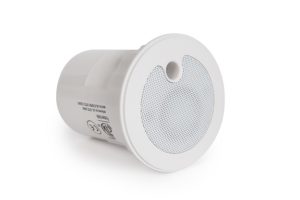
If your office space has conventional construction, having suspended acoustical ceilings with a nominal three foot space between the
suspended ceiling and the structure above, the best choice is to specify and install upward firing plenum mounted speakers. These
speaker are typically installed on 15-16 foot centers and fill the room below with non-directional, ambient sound. One of the traits of a well
done sound masking system is that one cannot discern where the sound is coming from. Plenum mounted speakers produce the effect of
every tile being a "speaker" as the sound is reflected above the ceiling and filtered through the tiles producing an unobtrusive and uniform
sound.
Openings in the suspended ceilings, such as return air grilles, should be accounted for, either by adjusting or relocating the nearest
speaker, or by using an inexpensive return air grille attenuator.
A major benefit from upward firing, plenum mounted speakers is the "spill-over" effect. Most offices have a core open office area
surrounded by perimeter closed offices. In many cases, with proper design, the closed offices can be appropriately masked by spillover
from the near by open office speakers.
A popular construction trend for green buildings and those spaces which are designed to make an architectural statement, is to omit the
suspended ceiling. This approach works well, acoustically, when there is sufficient height to the structure above. Depending on the height
of the structure, speakers may need to be placed sightly closer together in order to assure spatial uniformity. In open structure the best
speaker selection is upward firing speakers similar to the type used in the plenum above a suspended ceiling.
Under floor sound masking systems have risen in popularity due to the increased use of access floors. The reverberant under-floor cavity
creates an ideal location for sound masking speakers. There are, however, some caveats. Floor penetrations and the perimeter of the floor
must be properly sealed to avoid hot spots. Under floor sound masking systems can outperform other systems for spatial uniformity,
however they are not suited to all access floor environments and require a consultant or contractor skilled in the design and installation of
under-floor sound masking systems.
In most applications, the least desirable choice for sound masking distribution is the "direct field" speaker. These speakers are typically
installed in suspended ceilings and aimed downward at the room occupants causing a "spot-light" effect. Regardless of the broad
dispersion pattern produced by modern direct field speakers or emitters, in most applications they cannot produce the spatial uniformity of
speakers which fill the plenum and the room below with indirect ambient sound filtering through every ceiling tile.
In some cases a direct field masking system may be more easily tuned, since there are no plenum variables to consider during the tuning
process. The design consideration that is often not considered with direct field speakers is that one must now consider in-room
obstructions such as tall panels which can cause acoustical shadowing, especially where there are tall panels and relatively low ceilings.
Direct field speaker are the correct choice when there are no other options, such as a room having drywall ceiling with little access above.
They can also work well with high ceilings and low panels.
In closed office environments a direct field speaker must be put into every office as there is no "spill-over" effect from the plenum space as
is the case with upward firing speakers. In all cases a sound masking system using direct field emitters will require more speakers than an
ambient system. The emitters will likely also have to be relocated during office reconfigurations. These systems are also more expensive to
relocate as a hole is typically cut into the ceiling tile during installation.
Distributed systems
Centralized systems
Networked systems
Hybrid systems
In the classic distributed system there is no central generator or amplifier. Each speaker contains it's own generator, which is an ideal
solution for very small systems, with little or no growth planned.
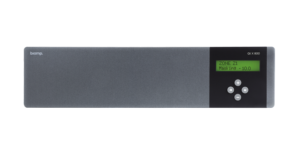
In the classic centralized system there is a central equipment rack housing the system generator,mixers and amplifiers. Speakers are wired
into specific zones. Every speaker has a volume control. This approach is still the most common and can offer more adjustment, per
speaker, than some network approaches.
Probably the most significant industry trend is the trend toward network, addressable sound masking systems. These system use
network cabling to connect all speakers or speaker controllers. This allows reconfiguration of the entire system without the need to
rewire speakers or zones.
It is important to verify that the design provides for every speaker to be addressed. It is not good practice to connect multiple speakers to
a single address. There is little advantage to a network system if speakers are wired in clusters, effectively giving less volume control per
speaker that the older type centralized systems.
Network systems have blurred the classic distinction between centralized and distributed systems. A network system should provide for a
multi-channel central sound masking / paging "broadcaster" sending digital networked audio through the network. It should also have
the capability to perform as more of a sophisticated distributed system with soundmasking being generated at the speaker controller
level.
Beware of addressable or networked systems that specify "primary" and "secondary" speakers as the secondary speakers are not
individually adjustable. Also beware of the tactic of placing more than one speaker on a "speaker channel" as the speakers can only be
adjusted as a group. Some companies may install as many as eight speakers on a single speaker channel while touting the system as
addressable.
Sophisticated sound masking systems comprised of traditional centralized equipment can be integrated with networked systems and
hardware providing a hybrid approach. Perhaps there is no real need to address every speaker over a large call center, for example. At
the same time there may be a need to quickly change the level or function of speakers installed in the conference, training rooms or
executive areas of an office. Dynasound can design a system, based on your specific current and future needs, using the best of the
available technologies.
Sound masking was created in the 1970s to address the lack of speech privacy in open office workstations. Upward firing speakers were
used over direct field speakers to create spatial uniformity and to create sound masking systems that were effective and unobtrusive. As
the laws of physics have remained constant, this is still the best approach.
For many applications, the classic centralized system is still a valid choice. The power and flexibility of a networked system is minimized in
value if it's seldom or never adjusted.
Network systems will continue to be the state of the art in sound masking. As all other building systems become network based and
controlled by facility managers, users will expect the same level of control over speech privacy and paging systems.
Make sure when selecting a networked sound masking system that every speaker is individually addressable.
For questions or additional information please contact:
Patrick Gillilan
V.P. Chief Technical Officer
Dynasound, Inc.
gillilan@soundmasking.com